
Nano Banana 2.1 vs GPT Image 2.5 is a close comparison with different winners depending on the brief. In the examples below, Nano Banana 2.1 follows a requested camera position and miniature cutaway more closely. GPT Image 2.5 Flare delivers stronger results in several typography, product photography and detailed illustration examples.
The important version detail: the comparison boards identify GPT Image 2.5 Flare, not Sunburst. We examine seven image pairs from TechHalla's 20-prompt thread, published on October 7, 2026. This article adds our visual analysis and practical selection advice; the original images and their scores belong to TechHalla.
By Nano Banana 2 Editorial · Select any comparison image to inspect the complete board at full size.
Quick verdict: which model should you try first?
For a photographic product hero or a poster with controlled geometry, these examples make GPT Image 2.5 Flare a useful first candidate. For a brief where the camera angle, spatial arrangement or stylized material is essential, Nano Banana 2.1 deserves an equally serious test. The most attractive picture is not always the most accurate answer to a prompt.
The following numbers are TechHalla's displayed mean scores for these seven individual examples. They are subjective scores from the original boards, not our measurements or a combined result for all 20 prompts.
| Example | Nano Banana 2.1 | GPT Image 2.5 Flare | What separates the outputs |
|---|---|---|---|
| Tokyo expressway | 8.7 | 7.0 | Camera position and direction of travel |
| Concert poster | 6.7 | 8.7 | Controlled geometry and print texture |
| Coffee infographic | 8.3 | 9.0 | Reading order and icon treatment |
| Hot sauce product shot | 8.0 | 9.0 | Label styling and unrequested copy |
| Ramen shop miniature | 8.7 | 8.0 | Cutaway structure and clay-like material |
| Ironworkers group scene | 7.3 | 8.7 | Plausible body placement in a crowded scene |
| Watercolor storybook | 8.3 | 8.7 | Detail, style and the character's position |
What this comparison does—and does not—measure
TechHalla describes the outputs as first attempts. The boards also state that they were not upscaled or retouched. His criteria cover following the prompt, visual appeal, and composition/coherence. Different examples use different sizes and aspect ratios, so inspect each board's labels when comparing results.
The source thread is marked as a paid partnership and says the tests were run on Magnific. Treat it as an attributed creator test. It does not establish an independent benchmark, average generation time, API cost, or editing reliability. The original thread explicitly leaves editing for another review. Its overall preference is slightly toward GPT in this set, particularly photographic detail; the individual examples reveal why that preference is not universal.
1. Prompt accuracy: the Tokyo night-drive example
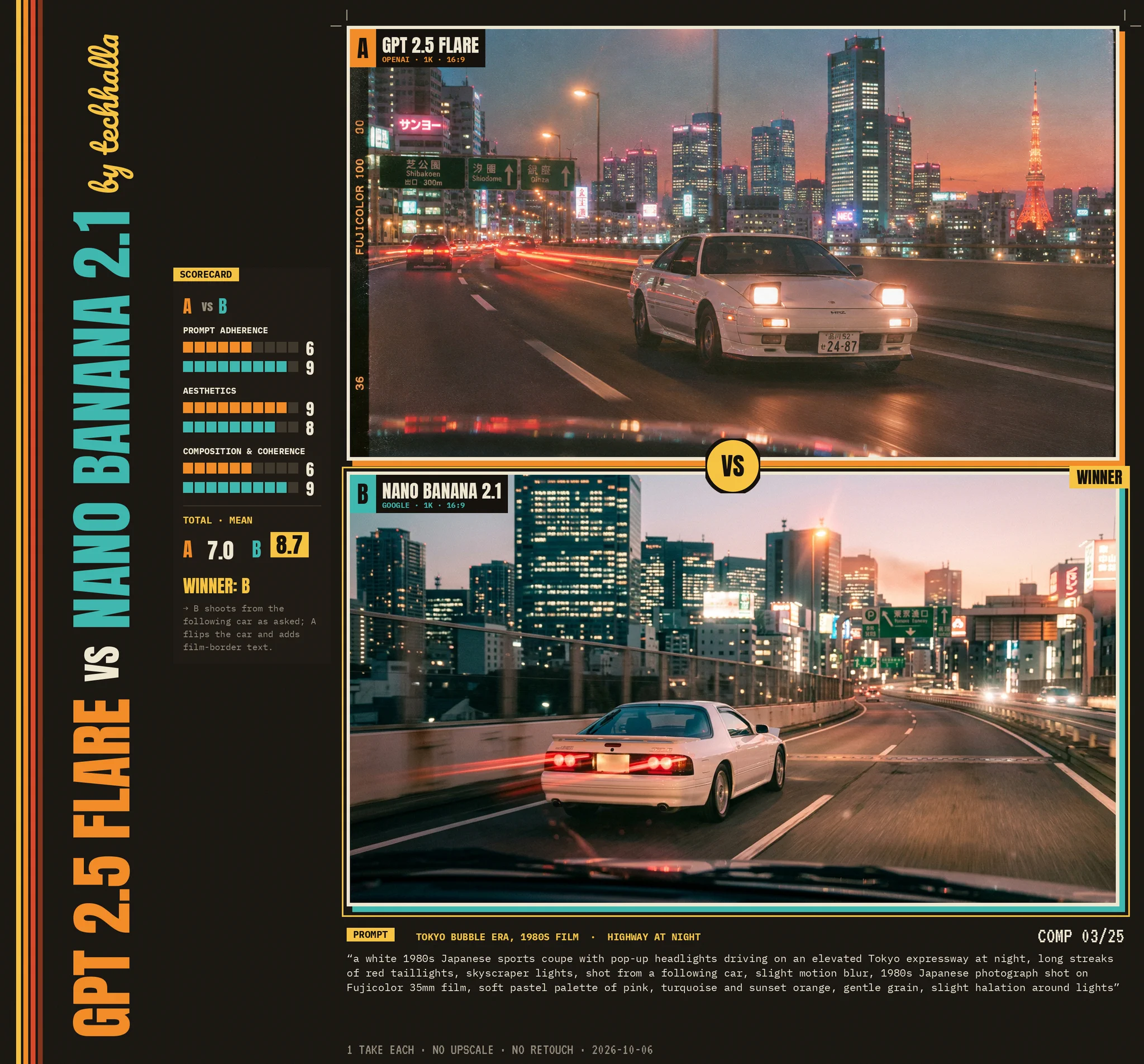
Both pictures deliver luminous city buildings, an older white sports car and warm road lighting. The decisive difference is the viewpoint. In the GPT result, the car faces the viewer. Nano Banana places the viewer behind it, with the following vehicle's dashboard visible along the lower edge.
That makes this a useful lesson for anyone creating a storyboard. A frame can look cinematic while reversing the intended action. Before judging reflections or grain, check where the camera is, where the subject is going and which side of the subject should be visible. Nano Banana's interpretation fits that spatial instruction more closely in this pair.
For your own prompt, specify the camera relationship before aesthetic modifiers. “Camera behind the subject” and “the rear of the car is visible” describe an observable result. A long list of film stocks and color adjectives leaves that central relationship less explicit.
2. Text rendering: a concert poster needs hierarchy
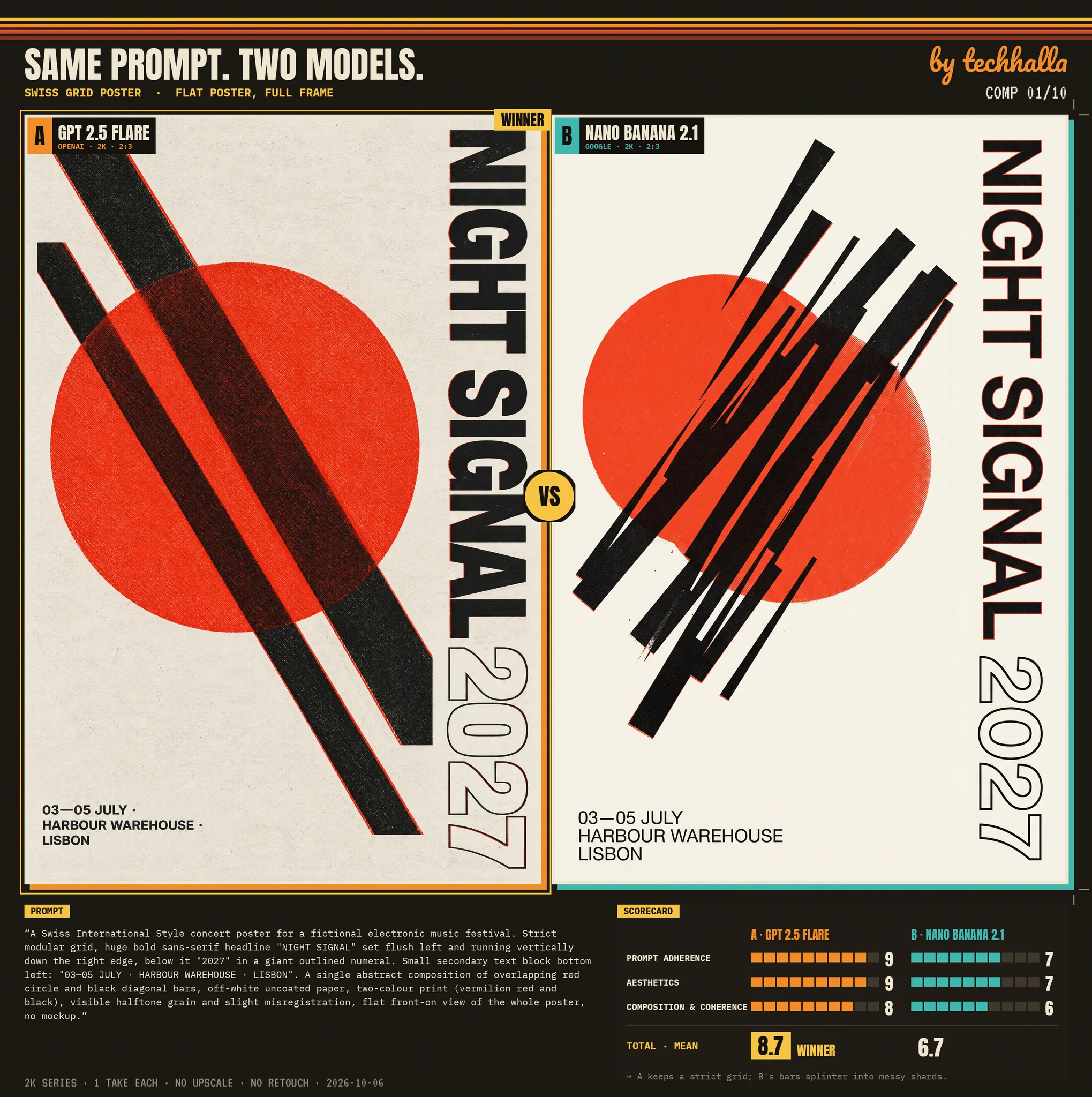
The large headline and event details are readable in both posters. The distinction is graphic discipline: GPT uses broad, stable diagonal forms, while Nano Banana breaks the black shapes into a busier cluster of narrow shards. The GPT version also has a more visibly weathered printed surface.
For a concert flyer, packaging insert or social campaign, correct spelling is only the first requirement. The image must still have a clear headline, a place for secondary information and a shape system that matches the requested style. In this example, the GPT poster gives the central geometry more visual weight and fewer competing edges.
A practical review should happen twice: at full resolution for individual letters, then at the size a viewer will actually see. Small text that is technically present can still fail as an advertisement if it disappears in a mobile feed.
3. Infographics: readable labels are only half the job
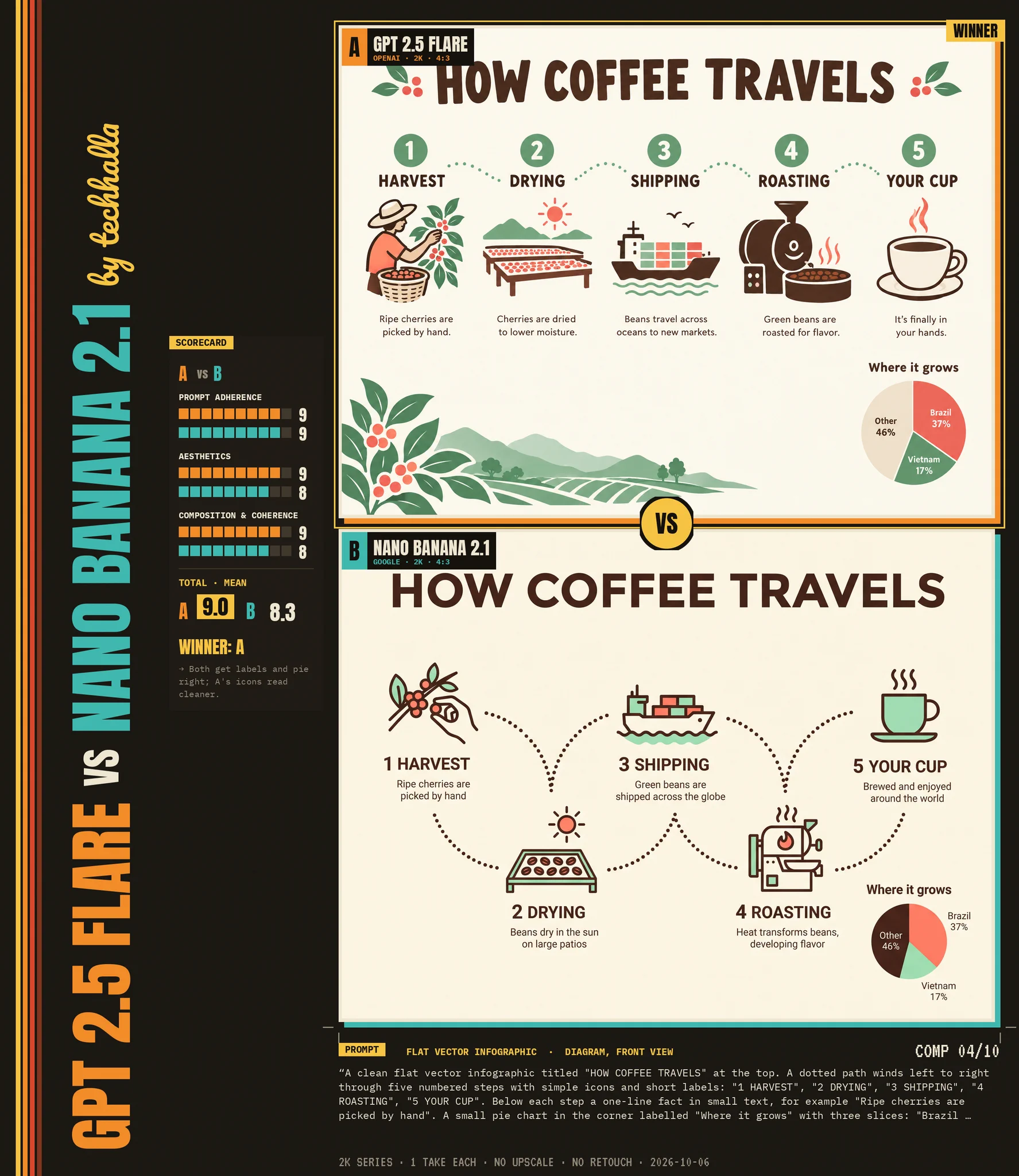
Both versions include the five numbered stages and a small pie chart. GPT keeps the process in a single horizontal sequence. Nano Banana alternates the steps vertically, creating a more winding reading path and more empty space between the title and the icons.
The useful question is how quickly a reader can recover the sequence. A horizontal arrangement may suit a slide; a staggered composition may give larger individual illustrations more room. Neither choice should be judged without knowing where the graphic will appear.
Also separate typography from data integrity. A correctly rendered percentage is not evidence that the percentage is true. The figures here are part of a fictional test prompt, not verified coffee-market statistics. For a real infographic, supply checked data, verify every label and number, and inspect whether chart areas actually correspond to the values.
4. Product photography: inspect the label, not just the lighting
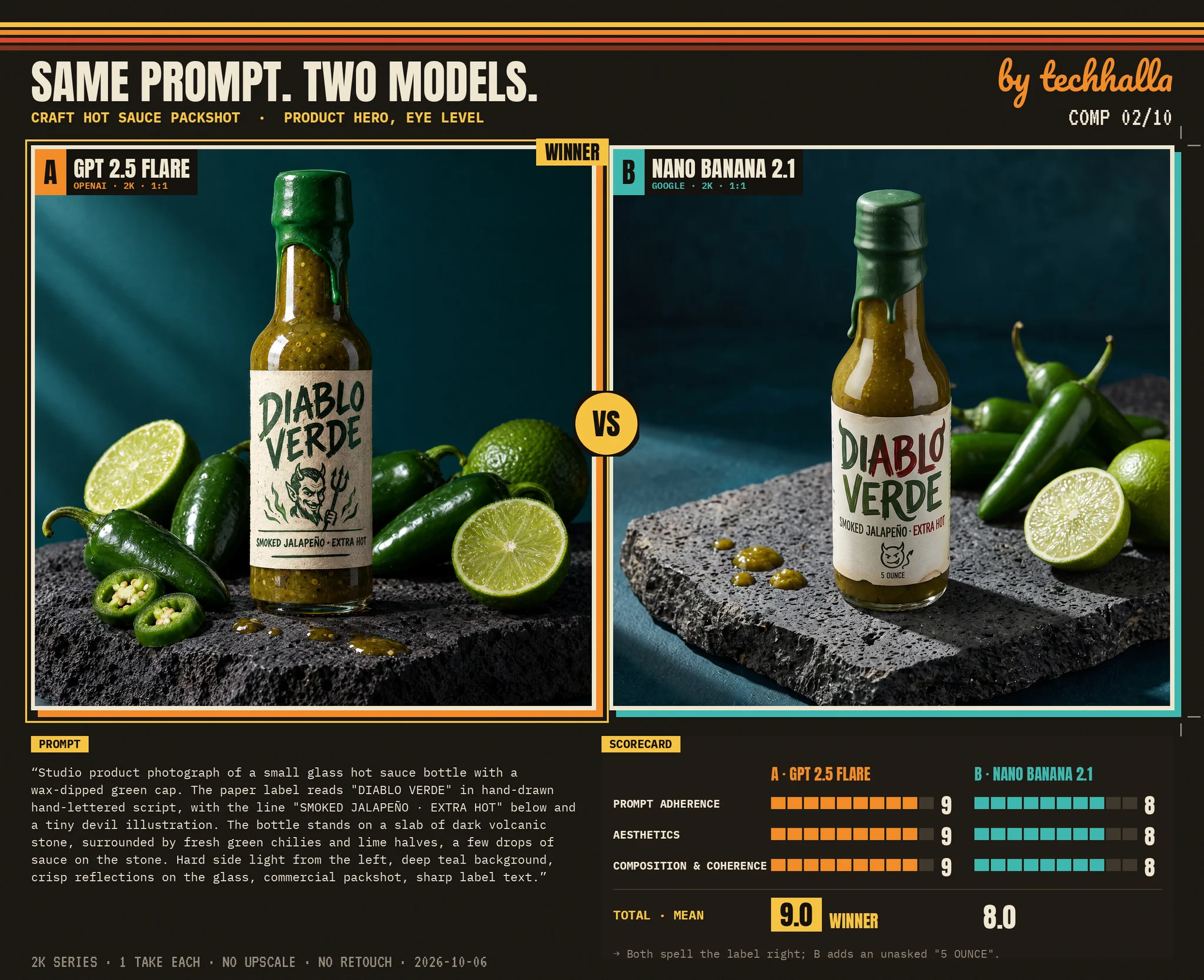
Both outputs place a green-capped bottle against a dark teal background with citrus and peppers. GPT gives the label a larger illustrated character and a rougher hand-drawn identity. Nano Banana chooses more formal lettering and adds a package-size line that was not requested.
That extra line matters for ecommerce. Invented volume, ingredients or claims can turn a convincing packshot into an inaccurate product listing. Review the entire label, including small text near the bottom, rather than accepting the image because the main brand name is readable.
This pair also shows how props change the product's emphasis. GPT fills more of the foreground with ingredients; Nano Banana gives the stone platform more breathing room. Choose the arrangement that matches the intended crop and the space needed for your own headline or purchase button. For an existing product, use a real reference and verify packaging fidelity separately from this text-to-image example.
5. Composition: the miniature ramen shop favors Nano Banana
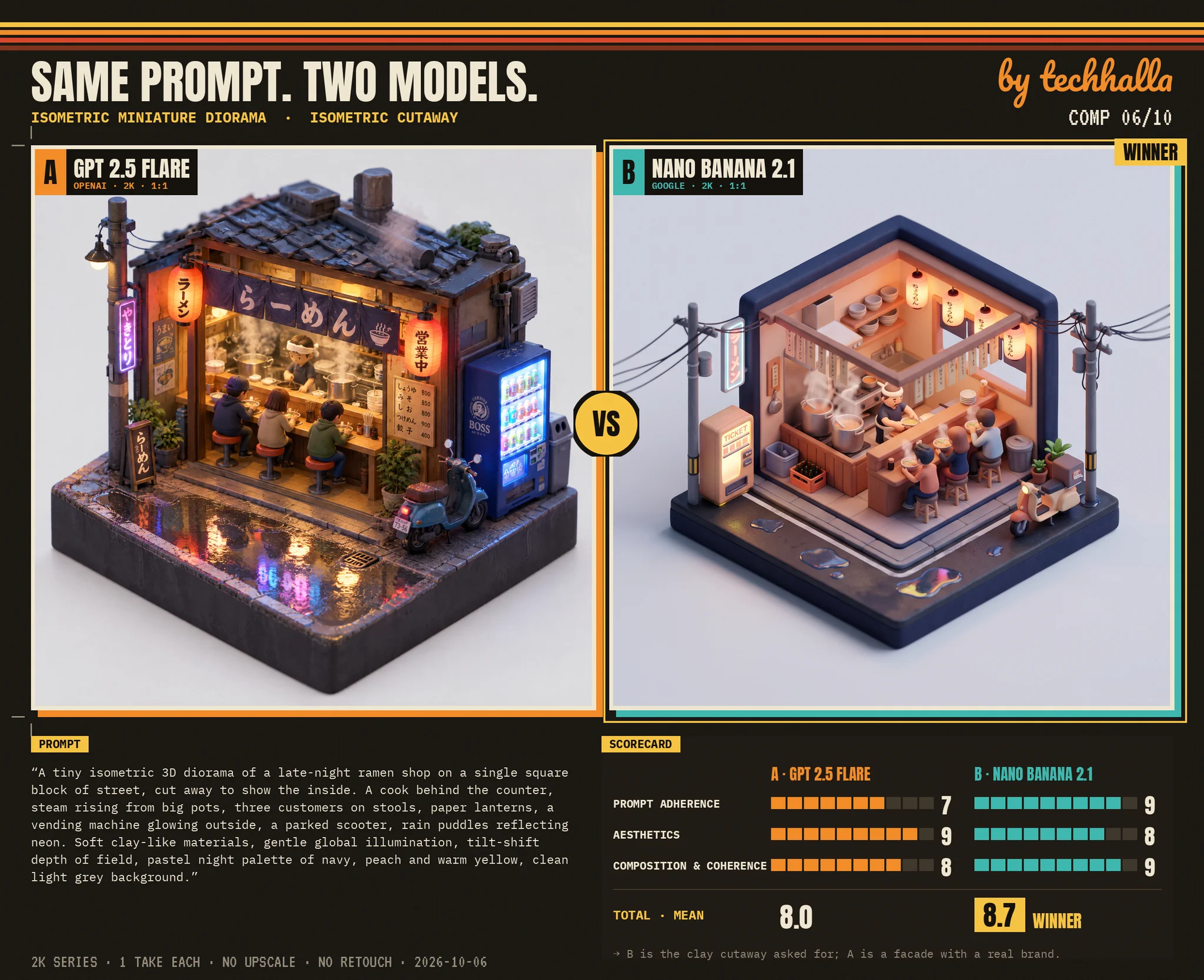
GPT's miniature is dense with wet pavement, roof tiles, signs and reflected light. Nano Banana's version opens the room, simplifies the objects and gives the scene a softer, toy-like appearance. Both are appealing, but they answer different visual briefs.
For an explanatory cutaway, the removed walls and visible interior are the main deliverable. Surface detail cannot compensate for obscuring that structure. Nano Banana makes the cook, counter and customers easier to read as parts of a small model, which is why this example is especially relevant to diagrams, game assets and illustrated location cards.
When evaluating stylized work, write down the required material as well as the objects. Clay, paper, plastic and painted wood imply different edges and surfaces. A more realistic output may be a worse fit if the assignment calls for a deliberately simplified miniature.
6. Photographic detail: group scenes expose spatial mistakes
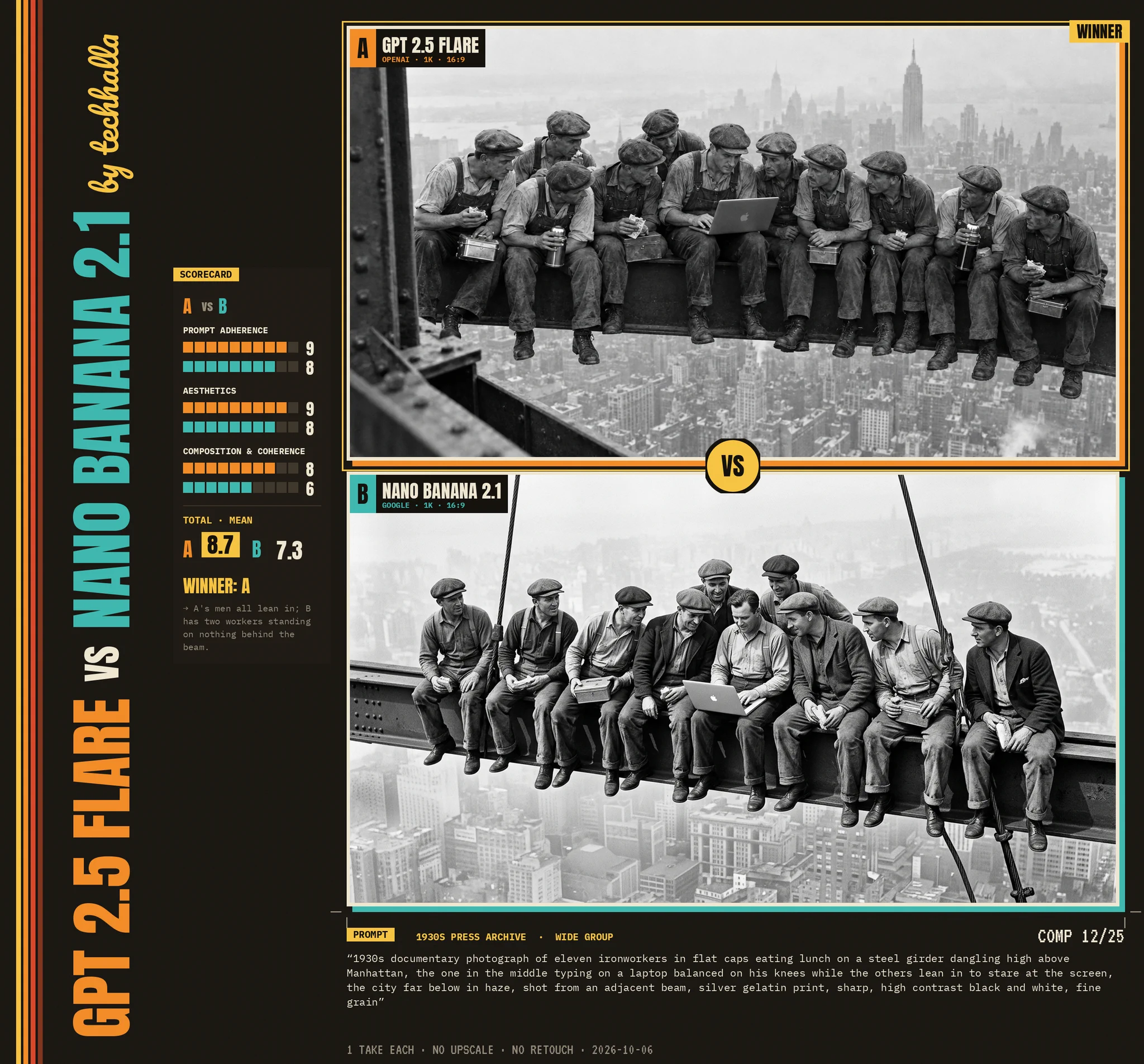
This is an intentionally fictional scene combining a period photograph aesthetic with a laptop. The anachronism is part of the brief. The more useful inspection concerns physical relationships: where each person sits, what supports the body and how the group gathers around the screen.
In Nano Banana's result, two rear figures appear elevated behind the seated row without clear support. The GPT composition groups the workers more tightly around the central object. At thumbnail size, both images read as convincing old photographs; closer viewing exposes differences in scene logic.
For crowded portraits, inspect hands, knees, feet, overlapping bodies and contact with furniture or the ground. These checks are more informative than simply counting visible faces or judging the overall black-and-white treatment.
7. Illustration: richer texture is not always the desired style
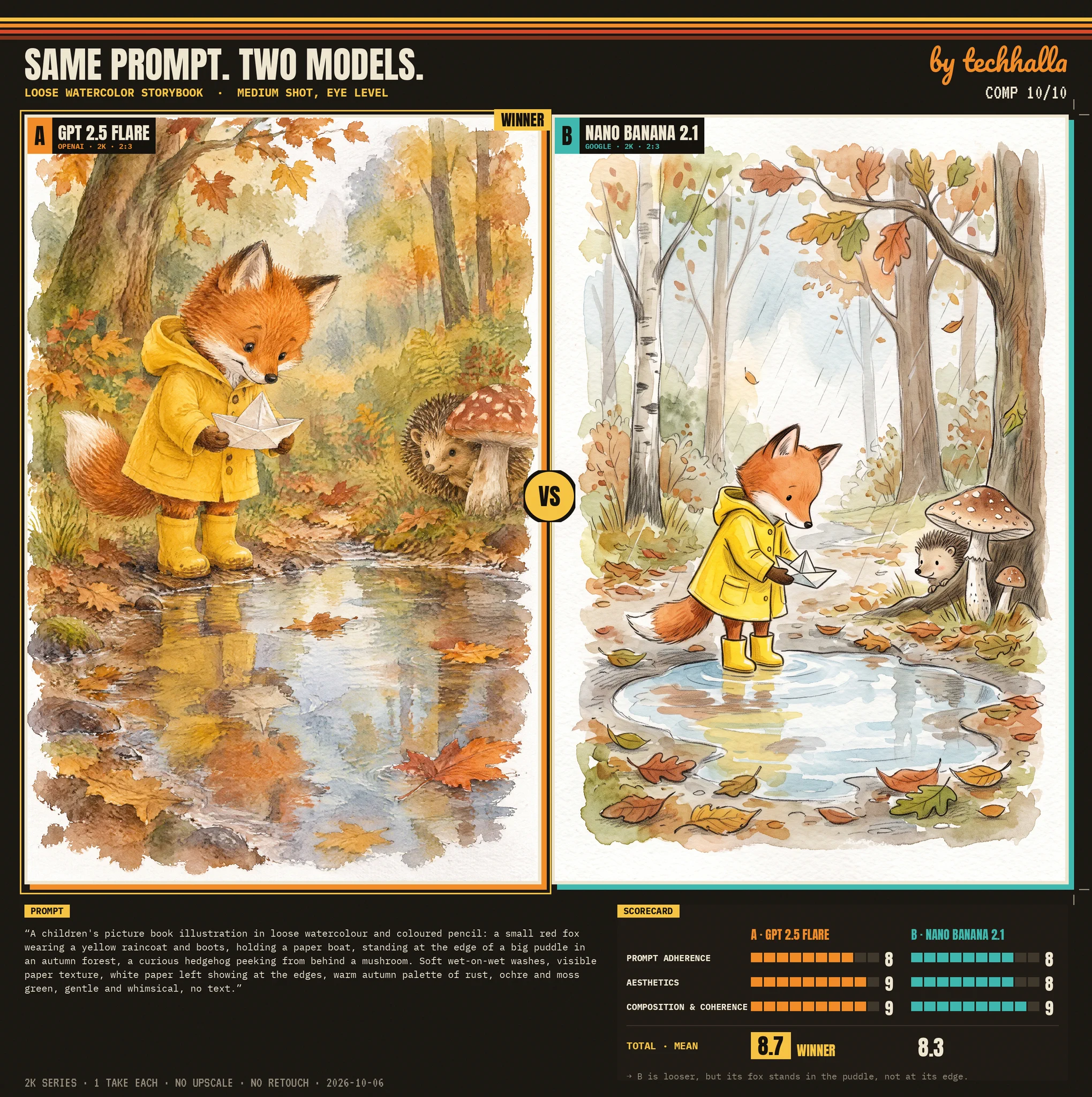
GPT paints a fuller forest with dense fur, foliage and reflections. Nano Banana uses more visible outlines, lighter washes and a smaller character within a taller open setting. The fox's position also differs: one stands by the water, while the other is visibly in it.
For a single finished illustration, you may prefer the richer image. For a book spread, a simpler scene may leave more room for typography and work better alongside neighboring pages. That is an editorial decision about the finished object, not a universal measure of model quality.
These two pictures also cannot establish character consistency across a book. That requires generating multiple scenes with the same reference and checking costume, proportions and facial features through the sequence.
Model capabilities and the Flare/Sunburst distinction
Nano Banana 2.1's official documentation describes 1K, 2K and 4K image generation, with improvements to text rendering and consistency through successive edits. Those specifications provide context; the seven selected images do not test every capability.
The GPT Image 2.5 family includes two distinct choices. The official model pages position Flare for fast, high-quality generation and Sunburst for workflows emphasizing precise editing. The boards here use Flare. An editing result from Sunburst would be a different comparison.
How to choose for your own workflow
Start with the job you need to finish. For product images, make label accuracy and packaging shape mandatory. For posters, prioritize exact copy, hierarchy and usable margins. For storyboards, prioritize camera placement and continuity. For illustration, agree on the medium and the space needed for text before choosing the prettiest sample.
Run the same brief at comparable output sizes and quality settings, keep the complete set of attempts and review the results without model labels if possible. Record time and cost alongside the number of images that actually pass your requirements. A model that needs fewer revisions may be more economical even when its first generation costs more.
To explore the available controls, visit Nano Banana 2.1 and GPT Image 2.5. In the image workspace, check the exact model variant and displayed credit cost before generating your own comparison.
Frequently asked questions
Is Nano Banana 2.1 better than GPT Image 2.5?
It depends on the task. The selected examples show Nano Banana handling some spatial instructions more faithfully, while GPT Image 2.5 Flare has an advantage in several design and photographic examples. A useful choice starts with your own acceptance criteria.
Does this test use GPT Image 2.5 Flare or Sunburst?
The original image boards label the GPT model as Flare. The results should not be presented as a Sunburst test or as an evaluation of every ChatGPT image workflow.
Which is better for text inside images?
Both produce readable English text in the selected poster and infographic. Evaluate spelling, layout, reading order and unrequested text separately. These samples do not establish performance on Chinese text or every other language.
Which model is cheaper or faster?
This thread does not provide a controlled timing or cost comparison. Compare the actual resolution, quality setting, model variant and total attempts required for a usable image; check current prices in the service you use.
Were these images generated by Nano Banana 2's editorial team?
No. The comparison images and scores are TechHalla's original material. Our contribution is the analysis and workflow guidance above. See the complete source thread for the broader 20-prompt set.